
Compact Servo-Controlled Subwoofers for Professional Near-Field Monitoring

ServoBass® brings true low-frequency extension to desktop studios without the size, placement challenges, or muddy bass of conventional subwoofers.
Using proprietary Motion Feedback (MFB) technology, our compact desktop subwoofers deliver clean, controlled bass down to 30 Hz, extending the missing bottom octave while preserving the clarity, detail, and stereo imaging critical for music production, mixing, and critical listening.
Why ServoBass?
Most near-field monitors begin to roll off below 50–60 Hz, leaving engineers unable to accurately hear the lowest octave of their recordings.
Traditional floor-standing subwoofers can solve this problem, but often introduce new ones:
-
Room reflections and standing waves
-
Difficult integration with near-field monitors
-
Slow, resonant bass transients
-
Poor stereo imaging
-
Large physical footprint
ServoBass® was designed specifically to solve these challenges.
Its compact 8 × 8 × 8-inch enclosure fits directly beneath most studio monitors, creating a coherent near-field listening system with minimal room interaction.
Motion Feedback (MFB) Technology
Unlike conventional subwoofers that rely solely on enclosure tuning and passive driver optimization, ServoBass continuously monitors and corrects the motion of the woofer in real time.
A custom-designed accelerometer mounted directly on the woofer's voice coil measures cone acceleration. This signal is compared to the input signal through an all-analog servo control circuit, allowing the amplifier to instantly correct unwanted cone motion, resonance, and nonlinear distortion.
The result is bass that is:
-
Deep
-
Fast
-
Accurate
-
Exceptionally well controlled
without the latency associated with digital signal processing.

Why It Sounds Different
Motion Feedback technology provides several important advantages:
-
Flat frequency response from 30–400 Hz
-
Exceptionally fast transient response
-
Reduced nonlinear distortion
-
Lower thermal compression
-
Consistent performance over the driver's lifetime
-
Deep bass from a compact sealed enclosure
-
No DSP latency
Instead of relying on resonant port tuning, ServoBass reproduces bass with precision and control, preserving the natural attack and decay of low-frequency instruments.
Frequency response
Green plot - with MFB disabled
Red plot - with MFB enabled

Cross Over response
ZRS-1 Crossover Response (Close microphone test) 100 Hz

ZRS-1 Crossover Response (Close microphone test) 200 Hz

ZRS-1 Crossover Response (Close microphone test)
Green - 100 Hz Blue - 200 Red - Wideband

Optimized for Near-Field Monitoring
ServoBass is designed to work as an extension of your studio monitors—not as a separate bass source.
Selectable 100 Hz or 200 Hz 4th-order Linkwitz-Riley crossovers remove low-frequency content from the monitors, reducing bass-midrange intermodulation and allowing them to reproduce vocals and instruments with greater clarity.
With the subwoofer positioned directly beneath each monitor, wavefront alignment at the listening position is maintained while minimizing room reflection effects.
The result is:
-
Improved stereo imaging
-
Better phase integration
-
Cleaner midrange
-
Accurate low-frequency reproduction
The ZRS-1 Desktop Subwoofer
The ZRS-1 combines a compact enclosure with advanced servo technology to create a powerful near-field monitoring solution.
Features
-
Proprietary Motion Feedback (MFB) technology
-
200 W RMS Class-D amplifier
-
Compact 8 × 8 × 8-inch sealed enclosure
-
6.5-inch long-throw driver with integrated acceleration sensor
-
30–400 Hz frequency response
-
Selectable 100 Hz or 200 Hz Linkwitz-Riley crossover
-
Wideband mode for external crossovers
-
Balanced TRS input and output
-
Front-panel bypass switch
-
180° phase switch
-
Variable subwoofer level control
-
Voice-coil thermal protection
-
Robust universal switching power supply (US & EU compliant)
ZRS-1 Block diagram

Measured Performance
ServoBass performance is supported by objective measurements.
Our Motion Feedback system produces a significantly flatter low-frequency response while reducing resonance and distortion.
Frequency response and crossover measurements demonstrate seamless integration with near-field monitors while maintaining accurate bass reproduction throughout the listening range.
THD & 3rd Harmonics Reduction by MFB


The ZRS-1 Desktop Subwoofer
Whether you're mixing music, mastering, editing video, designing sound, or simply demanding the most accurate desktop monitoring possible, ServoBass delivers the low-frequency extension your monitors were never designed to reproduce.
Experience deeper bass, greater clarity, and a more accurate monitoring environment—without sacrificing valuable studio space.
Why ServoBass?
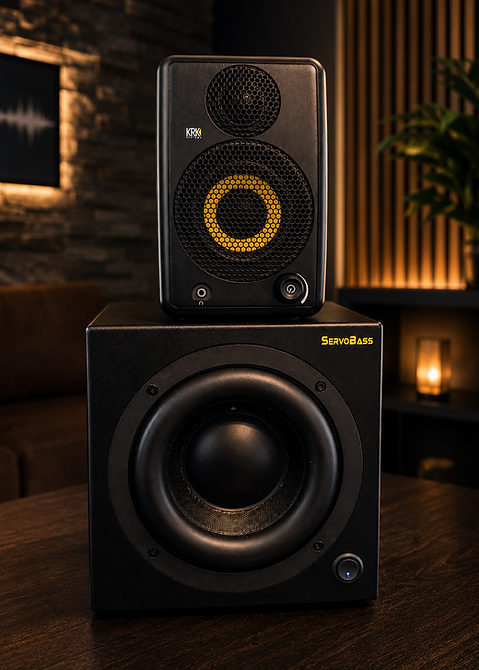
Not all subwoofers are designed for near-field monitoring.
Traditional subwoofers were developed primarily for home theater and consumer audio, where maximum output is often prioritized over speed and accuracy. ServoBass® was engineered specifically for professional monitoring, where transient response, low distortion, and precise stereo imaging are essential.
Feature Conventional Ported Subwoofer ServoBass® MFB Subwoofer
Low-frequency extension Good Excellent
Bass transient response Resonant / slower Fast and tightly controlled
Distortion Higher at high excursion Significantly reduced
Stereo imaging Placement dependent Optimized for near-field
Desktop integration Large floor unit Compact 8×8×8" desktop design
Room reflections Significant Minimized
Woofer control Passive Active Motion Feedback
DSP latency Often present None (all analog servo loop)
Bass character Port resonance Natural, accurate bass
Monitor integration Can be difficult Designed specifically for near-field monitors
Designed for Accuracy
ServoBass is not designed to create exaggerated bass.
It is designed to reproduce exactly what is in the recording.
By continuously monitoring and correcting woofer motion, ServoBass maintains exceptional control over low frequencies, allowing engineers to hear the true balance of a mix.
The Technology
Motion Feedback (MFB)
Servo-Controlled Bass
At the heart of every ServoBass subwoofer is Motion Feedback (MFB) technology.
Unlike conventional loudspeakers, ServoBass continuously measures the actual motion of the woofer cone and compares it to the original input signal.
Any deviation is corrected instantly through an all-analog negative feedback loop.
The result is bass reproduction that remains accurate even at high output levels.
How It Works
A custom-designed accelerometer is mounted directly to the woofer's voice coil former.
As the woofer moves, the sensor continuously measures cone acceleration.
This signal is fed back into the amplifier's servo control circuit where it is compared with the incoming audio signal.
The amplifier immediately compensates for:
-
Cone resonance
-
Driver nonlinearities
-
Mechanical inaccuracies
-
Thermal effects
-
Changes caused by driver aging
The correction happens continuously in real time.
Why Analog?
Many modern loudspeakers rely on DSP processing.
ServoBass uses an all-analog servo loop.
Advantages include:
-
Zero digital latency
-
Instantaneous correction
-
No sampling artifacts
-
Extremely stable operation
-
Natural transient response
Why a Sealed Enclosure?
Most subwoofers rely on bass reflex ports to increase low-frequency output.
Although effective, ports introduce stored energy that continues to resonate after the musical signal has stopped.
ServoBass uses a compact sealed enclosure combined with Motion Feedback.
The result is:
-
Better transient response
-
Improved impulse accuracy
-
More natural bass
-
Reduced overhang
-
Lower distortion
Near-Field Integration
ServoBass is intended to become part of your monitor system—not a separate bass source.
Positioning each subwoofer directly beneath the studio monitor provides:
-
Wavefront alignment
-
Reduced room interaction
-
Improved phase coherence
-
Exceptional stereo imaging
Applications
Professional Recording Studios
Hear the entire frequency spectrum with confidence.
ServoBass extends monitor performance to 30 Hz while maintaining the speed and accuracy required for critical production work.
Ideal for:
-
Recording
-
Mixing
-
Mastering
-
Dolby Atmos production
Home Studios
Small rooms often make large subwoofers impractical.
ServoBass delivers professional bass performance without occupying valuable floor space or exciting unnecessary room modes.
Perfect for:
-
Bedroom studios
-
Project studios
-
Content creators
-
Podcast production
Music Production
Low-frequency instruments become easier to judge.
-
Kick drum
-
Bass guitar
-
Synth bass
-
Electronic music
-
Film scores
ServoBass reproduces these frequencies accurately without masking important midrange information.
Video & Film Post Production
Dialogue clarity depends on accurate bass management.
ServoBass provides clean low-frequency monitoring for:
-
Video editing
-
Film mixing
-
Game audio
-
Sound design
-
Broadcast production
Desktop Audiophile Listening
ServoBass isn't only for professionals.
It transforms desktop music listening by adding the lowest octave without the boominess associated with conventional subwoofers.
Experience:
-
Greater realism
-
Better instrument separation
-
Improved soundstage
-
Tight, articulate bass
-
Accurate stereo imaging
Why Professionals Choose ServoBass?
✔ True 30 Hz extension from an 8×8×8-inch enclosure
✔ Proprietary Motion Feedback technology
✔ Extremely low distortion
✔ Fast, accurate transient response
✔ No DSP latency
✔ Designed specifically for desktop near-field monitoring
✔ Seamless integration with studio monitors
✔ Compact footprint
✔ Balanced professional connections
✔ Built for critical listening—not exaggerated bass
Additional Reading
The linked articles explore the history of passive and active bass enhancement methods and the design of the ZRS-1 desktop subwoofer. Measuring 8x8x8-inch, the ZRS-1 complements small studio monitors by delivering powerful, tightly controlled bass in the 30–60 Hz range using Motion Feedback dynamic control of the woofer's voice coil.
About Our Subwoofers in the Sound on Sound newsletter
Read about our subwoofers in an article featured in AudioXpress
About our CEO Zami Schwartzman in AudioXpress
Motion Feedback Desktop Subwoofers in AudioXpress
